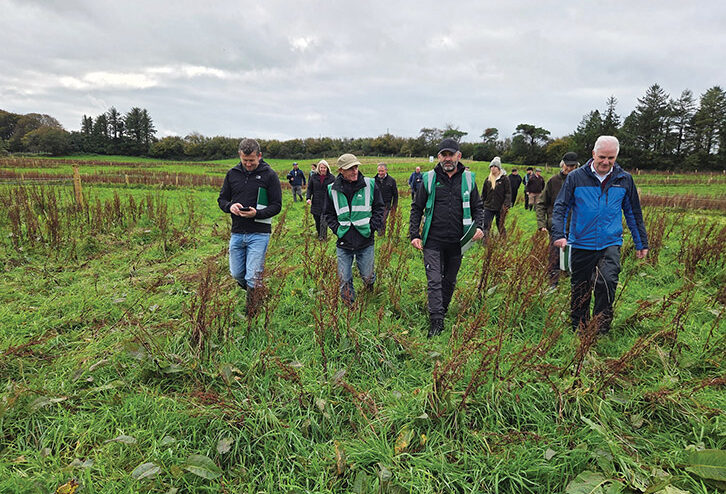
The impact of Storm Éowyn in January 2025 is still felt across the forestry industry. But with the support of Western Forestry Co-op, many landowners have since turned over a new leaf.
While Storm Éowyn was an exceptional event, it highlighted the volatility of the forestry and timber industry.
“Forestry is like a roller-coaster. You can have two good years and three bad. A lot of things are outside your control, whether it be climate, storms or Government policy,” Western Forestry Co-op CEO Noreen Barrett notes.
“Storm Éowyn was absolutely catastrophic for the industry. But we’re here to help people get back on their feet. You’ll always have ups and downs in forestry and our message to farmers and landowners is to be resilient, flexible and patient, as we navigate these challenging times. It’s just the nature of the business, we can advise and support forest owners on their best options and to help them access the new Windblow Reconstitution scheme.”
Based in Sligo, Western Forestry Co-op has over 40 years’ experience in advising farm families and communities on forestry. The Co-op was established in 1985 by the Dairy & Livestock Co-operatives in western counties in response to a need for support services for farmers considering forestry.
Western Forestry Co-op provides professional forestry services, including forest establishment (afforestation), management, harvesting, forest roads and a forest insurance scheme. The Co-op ethos of transparency, trust and loyalty are its foundation. Its team of professional foresters are available locally to advise farmers on how they can use forestry as the enabler to enhance their farming enterprises. Currently, there are a range of incentives and grants available to farmers to increase forest cover on their land and Noreen encourages them to look at the options available to them, and strongly consider woodland creation on their farms.
“Our experience and stability have helped us to navigate through many challenges, including the aftermath of Storm Éowyn,” Noreen says.
“We were set up by seven dairy co-ops to enable landowners to avail of grants at the time. We’re here to serve and to provide support to farmers and landowners wishing to integrate forestry into their set-up and to complement it. We’re run on co-op ethos.”
“New forests in Ireland need to be farm forests. They have to be part of the local community and owned by farmers. There are 12 different forest types that farmers can create and integrate into their overall farming enterprise. There are three main schemes within the current Forestry Programme – trees for timber (commercial crop); trees for nature (planting nature trees for biodiversity and the environment); and trees with farms (agroforestry).
“The agroforestry scheme is very popular as it allows farmers to plant trees and continue to keep cattle and sheep. The Government has increased the agroforestry premium which can be put back into the farm or reinvested. This is an example of how it can benefit farming rather than replace. It doesn’t have to be one or the other”..
“In addition, there are two native tree area schemes – native forest and farms, and native forest for water protection with a very generous 10 year income tax premium over 2k per hectare for small woodlands over 1 hectare, as well as other schemes which provide 20 years of income tax premiums for farmers. There are also schemes to help existing landowners with maintenance.
The CEO continues: “Ireland is currently 11% forested and the Government has set a target of 18%, meaning there will be ample opportunities for both landowners and the industry in the coming years. It goes without saying that a lot of work needs to be done to reach that target.”
The recent resignation of Michael Healy-Rae as Minister of State at the Department of Agriculture, Food and the Marine (DAFM) was a blow to the industry, according to Noreen.
“It was disappointing because he was a real champion for the forestry industry. He was all about getting things done. He brought plenty of energy to try and increase planting and did a lot to improve things, but he’s gone now. Hopefully, his successor will have the same passion and drive.”
Western Forestry Co-op has a diverse workforce consisting of employees from varying backgrounds.
“We have a 20-strong team from all walks of life,” Noreen explains.
“These include a quantity surveyor, two accountants, a horticulturist, an engineer, a former banker, an insurance professional, an ecologist and business graduates. We also employ a number of forest technicians who aid foresters. There’s a lack of foresters at the moment and it’s difficult to see that changing any time soon”..
“Furthermore, our team is multicultural and includes people from Germany, Belgium, Ukraine, South Africa and England. It’s exciting to see people from other professions wanting to change careers and connect more with nature. Forestry enables them to do that.”
“Our team is supported and supplemented by numerous tried and tested subcontractors who are involved in mounding, harvesting and haulage. We are proud to support local and generated €10 million for subcontractors alone in 2025. Every euro is reinvested in the local area. We are firm believers in a circular economy.”
A chartered certified accountant by profession, Noreen joined Western Forestry Co-op in 2016 as Finance Manager before succeeding Marina Conway as CEO in July 2024.
“I would have extensive experience of trends and cycles within the industry,” says the affable Sligo woman, who admits that the industry has a long way to go to achieve gender parity.
“It’s challenging. There are three other females in Western Forestry Co-op. They are Finance Manager Nichola Farrell, Forestry Technician Rossana Bacchetta and Insurance Scheme Administrator Méadhbh Murtagh. We’d like to get that number up over the next few years if possible.”
In another exciting development, Western Forestry Co-op will shortly relocate to a brand new head office in Collooney built entirely of wood and complete with a model forest.
“Our new site will have a model forest where we can show landowners and farmers the different varieties of trees we’ve planted. Forestry can work for farmers and they should talk to us about how they can best make this happen.”
Noreen concludes by saying: “They need to get the correct advice on how to build forestry into their overall farm mix. As they say, the best time to plant was 20 years ago, the next best time is now.
“There is a lot of competition out there for land for forestry at the moment. Western Forestry Co-op was set up to empower farmers to plant their own land rather than sell it. We believe that forest land is best served in the ownership of farmers and local communities than investment funds. We really want farmers to retain ownership of their land – forests are for farmers!
“The future of forestry in Ireland depends on farmers and we have to get as many of them as possible re-engaged in forestry.”
Western Forestry Co-op
Finisklin Road,
Sligo,
Co. Sligo.
Telephone: 071 9161458
Email: [email protected]
Featured, Western Forestry Co-op